I build infrastructure. For the last few months I have also been building an agentic system that runs it: software that watches a few hundred machines across five sites, predicts what a failure will do before it spreads, and corrects itself when reality disagrees. Somewhere in that work I noticed something I did not go looking for. The loop I had engineered for servers was the same loop running inside my own head. And inside the language models I was building with. And, if you follow it far enough, inside the idea of a self.
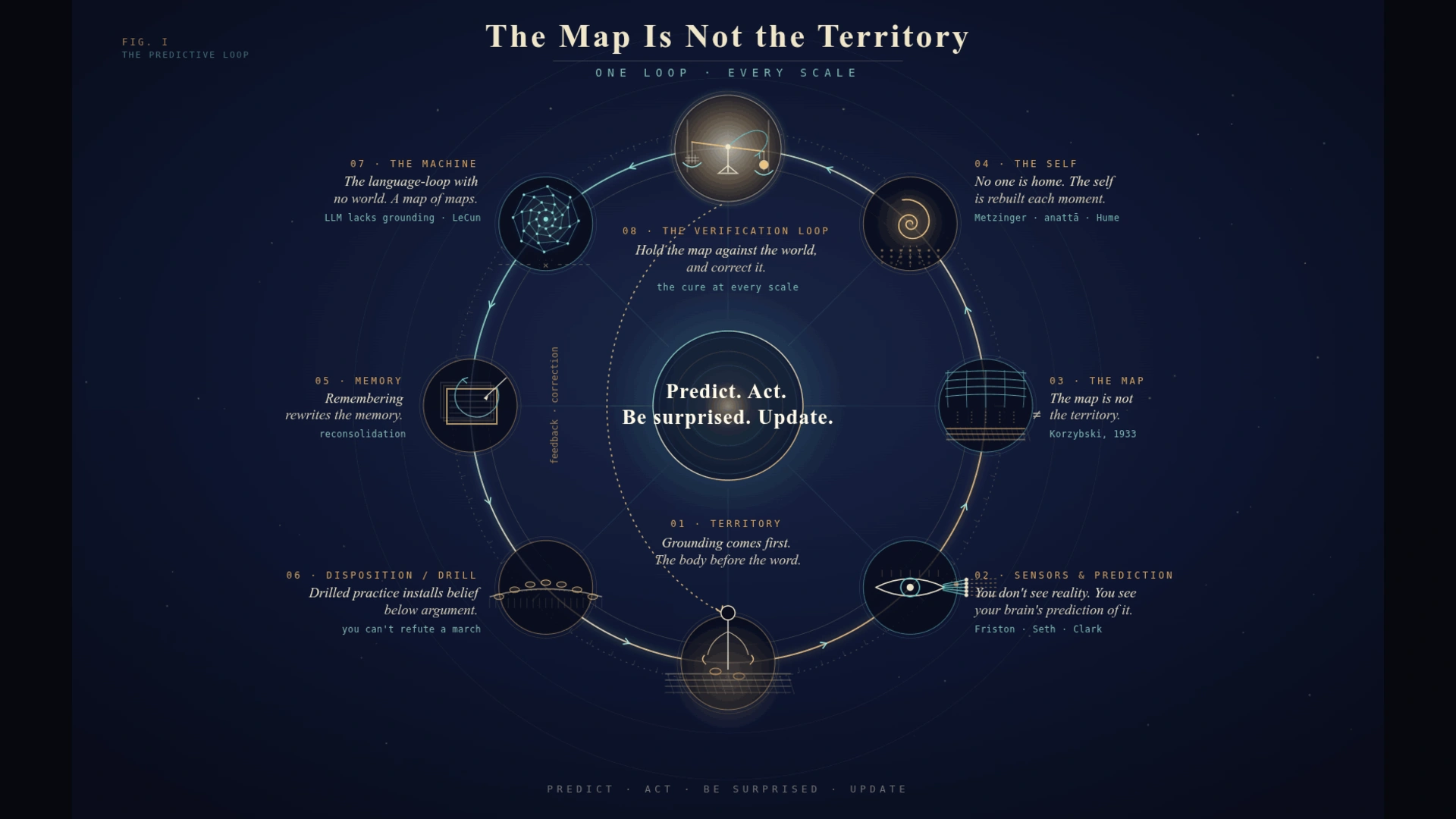
This article is about that loop. The diagram above is the whole argument on one page.
Start with the oldest line in the picture. “The map is not the territory.” Alfred Korzybski wrote it in 1933, in Science and Sanity. The point was simple and uncomfortable: the word is not the thing, the model is not the world, and many serious errors begin when we forget the difference. We mistake our description of reality for reality itself, and then we act on the description.
Modern neuroscience took the idea further than Korzybski could have. One of the most influential current frameworks for perception, predictive processing (Karl Friston, Anil Seth, Andy Clark), says you do not passively receive the world. You construct it, from predictions the brain makes and then corrects a beat late against sensory evidence. A table tennis player cannot react to a ball moving faster than ordinary reaction time, so they play the early cues, the posture and the racket and the learned regularities, and let the miss correct the guess. Anil Seth calls perception a controlled hallucination: an internally generated best guess, held in check by the senses and by the body’s basic need to stay alive. The phrase is his. The gloss is mine.
Then the self, which is the part that tends to unsettle people. If you look for a fixed self behind your experience, you do not find one. David Hume looked in 1739 and reported only “a bundle of perceptions” in constant motion. Thomas Metzinger’s modern version, in Being No One, is that there is no self as an entity, only a self-model: a representation the brain runs and cannot see as a representation, which is precisely why it feels like someone is home. The Buddhist doctrine of anatta made a related move two and a half thousand years earlier, though its purpose was liberation rather than neuroscience, and the two claims are not the same claim. Put them together and you get a position I hold rather than a result I can hand you: the self is less a thing than a process, rebuilt each moment out of the sediment underneath it.
Memory does not rescue you here, because memory is not passive archival playback. Recall is reconstructive, and under some conditions, often involving novelty or a prediction that failed, reactivating a memory makes it briefly editable before it is stored again. Not every recollection rewrites the memory, and strong old ones resist it. But the direction is the point. The hand that redraws the picture can change it.
And some of what runs us gets installed below the level where argument operates. Drilled practice, repeated daily, sediments into automatic routine, and a routine that is enacted rather than asserted is insulated from propositional correction in a way a stated belief is not. This is roughly why ritual outlasts reasoning. You can argue a person out of a creed more easily than out of a march. Mauss on techniques of the body and Bourdieu on habitus are the lineage for that, even if they do not prove the aphorism.
Now the machine, which is where my day job comes back into the picture. A model trained only on text is the language loop with no world underneath it. It learns which words follow which words, brilliantly, but the words are a map, and only ever a map. This failure has a name and a date. Stevan Harnad called it the symbol grounding problem in 1990: symbols defined only by other symbols, like a dictionary with no pictures, never connect to anything outside the dictionary, so they never quite mean. John Searle had made a closely related argument a decade earlier with his Chinese Room, about the gap between manipulating symbols and understanding them. A text-only model is, in the most literal sense, a map made out of other maps, floating, with no direct channel through which its claims can be tested against the world. That is Korzybski’s nightmare, running at scale. It is also why grounding a model matters, and why a model wired to tools, sensors, and real outcomes is a different animal from one left alone with its own text.
So here is the structure the diagram is actually about. The self, the brain, and the machine are the same loop on different substrates. I mean that as a claim about shared architecture, not literal identity. These are different systems answering different questions, and what recurs across them is a pattern, not one mechanism wearing three coats. The pattern is this. Predict, act, be surprised, update. And the component that decides whether such a system tracks reality or drifts into its own fiction is a single thing: an error channel it does not fully control. Something outside the model that is allowed to tell it no.
This is not abstract for me. It is the one principle the system I build is organised around. The agent is not allowed to act on a belief it has not checked, and the check is not run by the model that made the claim. The prediction is committed in advance, and a separate mechanism, code that reads logs and sensors and state, decides whether it came true. That separation is the whole point. Not because the code touches reality directly. It does not. It reads its own encoded observations, its own maps, and it can be wrong when a sensor lies, or a metric is only a proxy, or it happens to share a blind spot with the very thing it is checking. So the discipline is not verification against reality, which nobody gets. It is verification through a channel that can fail differently than the claim it is testing. An error signal the model cannot author for itself.
I am not the first to land on this, and it is worth saying who got here first. Cybernetics arrived in the 1940s and 50s. Norbert Wiener and Ross Ashby described adaptive behaviour as error-controlled regulation against a reference, and William Powers later built an entire psychology, Perceptual Control Theory, on that one loop. Karl Popper said a version of it about knowledge itself. For Popper, a claim earns the word scientific only if the world is allowed to refute it, and a belief system that has quietly arranged never to be refuted is exactly a closed dogma. That is the through-line, and it is old. A system that stops exposing its map to correction does not become wiser. It becomes an ideology, a hallucination, or a model confidently describing a world it has never touched. One caution the engineering taught me and the philosophy did not: reducing the gap to a reference is not the same as being right. A controller can be perfectly stable and perfectly wrong. Feedback is not truth. So the useful version is narrower than “get feedback.” It is: get feedback from a source that can fail differently than you.
I should be straight about the status of the larger claim, because the piece would be dishonest otherwise. That external, independent correction is what keeps a mind tracking reality rather than drifting into fiction is not a theorem I can prove. It is a position with a lineage, and it has serious opposition. Capable people argue that enough structure learned from text alone can approximate understanding with no world to check against, and they may turn out to be right. I do not think they are, and the disagreement is at least testable. The claim predicts that a system whose beliefs are never checked against independent evidence will, given enough autonomy and time, drift into confident and internally consistent fiction faster than one that is checked. That is a real experiment, an intervention and a control and a thing you can measure, not merely the observation that models sometimes make things up. It is the version worth running, and it is the one I am building toward.
The map is not the territory. The prediction is not the outcome. The self is not quite the thing it takes itself to be. No check reaches bare reality either. There are only better and worse maps, kept honest by evidence that fails differently than you do. Keep the one channel that is allowed to tell you no. It turns out to be most of the job.