I build around two problems I know from infrastructure work: keeping useful systems available when connectivity fails, and making operational automation accountable to the person on call.
MeshSat joins communication networks. Territory Grounder governs an SRE agent’s actions. CubeOS makes local services easier to run; MuleCube explores packaging offline computing into hardware. They share engineering concerns, but they have different users, maturity and commercial models.
- MeshSatPrototype · field validation next
Messages across mesh radio, satellite and mobile networks when connectivity is patchy or gone.
- Territory GrounderExperimental · mode-gated actuation
An SRE agent whose proposed infrastructure changes must pass checks outside the model.
- CubeOSBeta · untested pre-releases
A web-managed self-hosting platform for small computers and Linux machines.
- MuleCubePre-production · delivery unverified
A proposed portable box for offline reference material, maps and local applications.
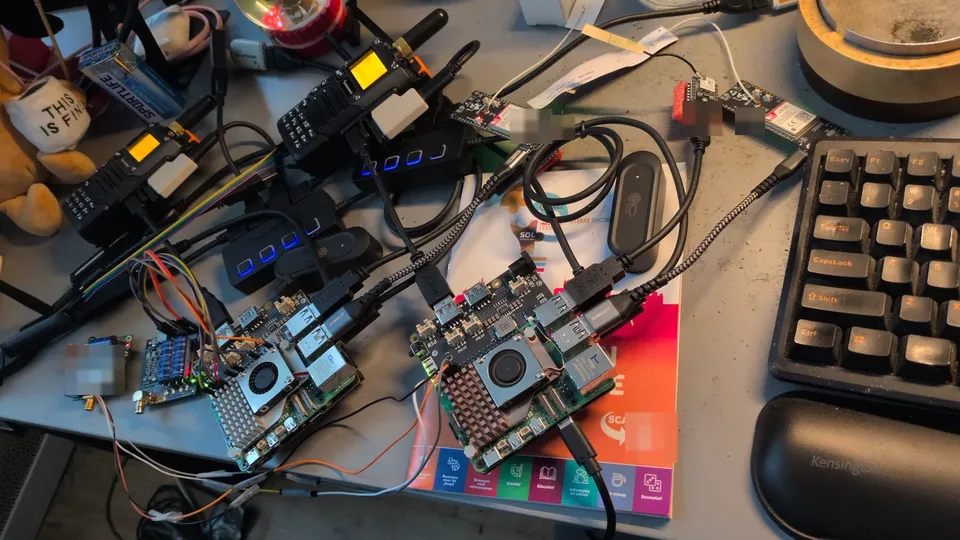
MeshSat
Prototype · field validation next
Messages across mesh radio, satellite and mobile networks when connectivity is patchy or gone.
Who it helps
Volunteer communications teams, field operators and radio builders who need to join otherwise isolated networks.
Approach and my contribution
A shared router with per-transport cost, payload limits and delivery results. Run a Bridge on Linux, use a phone gateway, and optionally manage devices through the Hub.
I direct the software, architecture and hardware integration. Elli Zafeiridou Georgiadou assembles hardware and leads verification and QA; George advises on PR and marketing. Most code is AI-assisted, with human review and hardware testing.
What works—and the limits
Bridge software, Hub and phone clients are public. Radio and satellite paths have run on our prototype hardware; the transport documentation distinguishes hardware-tested paths from code-only and bench work.
No real-user field deployment or emergency use is established. A working bench path is not proven emergency reliability. Satellite airtime, bandwidth and hardware still constrain delivery.
Evidence
SIDN fonds independently documents support for two field kits, satellite measurements and more accessible operation. Its project page names Elli. This funds validation; it is not evidence of customer adoption.
Commercial status
Bridge: GPLv3; Hub: Apache 2.0; hardware designs: CERN-OHL-S. Self-hosting is free software. Published hosted Hub plans are Free, Crew (€9/month) and Fleet (€29/month), with reviewed signup. Satellite/SMS airtime is bought separately. Hardware is being developed; these offers are not reported revenue.
Next step
The public plan is a six-month field programme starting November 2026: two portable kits for Dutch volunteer organisations, satellite measurements including failures, and usability work.
Explore the prototype · Source · Technical case study
Sources reviewed 2026-10-29: Team and testing · Transport readiness · SIDN fonds project · Recent changes
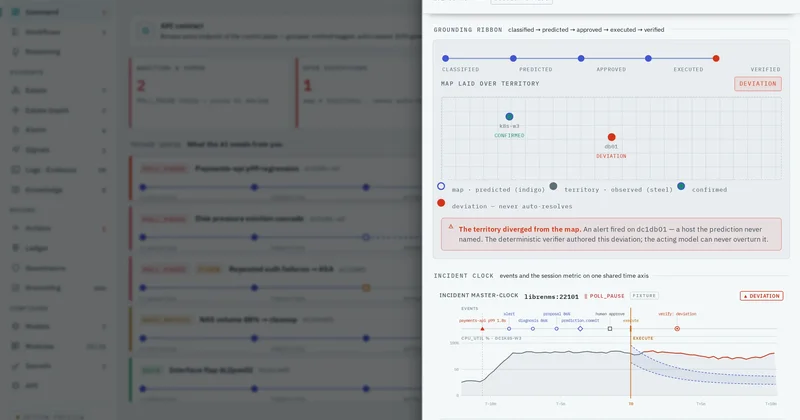
Territory Grounder
Experimental · mode-gated actuation
An SRE agent whose proposed infrastructure changes must pass checks outside the model.
Who it helps
Infrastructure operators who need incident investigation and controlled remediation inside their own environment.
Approach and my contribution
A Go control plane and Temporal workflows separate model reasoning from actuation, outcome checks and a hash-chained ledger. It grows out of my Agentic ChatOps work.
I set the architecture, governance rules and product direction, direct AI-assisted implementation, and operate the test environment.
What works—and the limits
The public repository reports deployed triage, an operator console and mode-gated actuation in an owner-set Semi-auto mode. Missing or invalid mode state falls back to read-only Shadow.
The product landing page still says mutation is off; the newer public README reports it enabled. This review follows the README for implementation status, not a fresh inspection of runtime settings. Operational assurance is still being evaluated.
Evidence
The public July 2026 comparison with its predecessor is an internal experiment. It reached 21 of 30 planned pairs and retained the predecessor under its frozen verdict. It does not establish independently benchmarked superiority or customer adoption.
Commercial status
Apache 2.0 self-hosted software. No paid offer or customer revenue is established by the public material reviewed.
Next step
Publish stronger evidence from real-action prediction checks, bounded canary runs and reproducible evaluations before widening confidence in autonomous operation.
Read the implementation · Source · Technical case study
Sources reviewed 2026-10-29: Current repository state · Evaluation harness · Design rationale
CubeOS
Beta · untested pre-releases
A web-managed self-hosting platform for small computers and Linux machines.
Who it helps
People who want local applications and storage without assembling every service by hand, including offline and field setups.
Approach and my contribution
Docker Swarm orchestration, a hardware abstraction layer and an offline-first dashboard bring application and device management together.
I conceived the platform and direct its architecture, AI-assisted implementation and testing.
What works—and the limits
Installer, Raspberry Pi images, source and a browser demo are published. The inspected release line reaches v0.2.0-beta.06; a demo demonstrates the interface, not installation reliability.
The download site explicitly labels releases untested and pre-production. ARM64 board support includes experimental targets. Do not treat the breadth of the platform list as verified compatibility.
Evidence
Public source and release artifacts are available. No independent deployment validation or customer adoption was established in this review.
Commercial status
Free software under Apache 2.0. No paid CubeOS service is established. MuleCube explores a separate packaged-hardware offer around offline self-hosting.
Next step
Hardware and installation validation is the outstanding release gate. There is no verified date for a production-ready release.
Sources reviewed 2026-10-29: Downloads and warnings · Release history · Dashboard demo
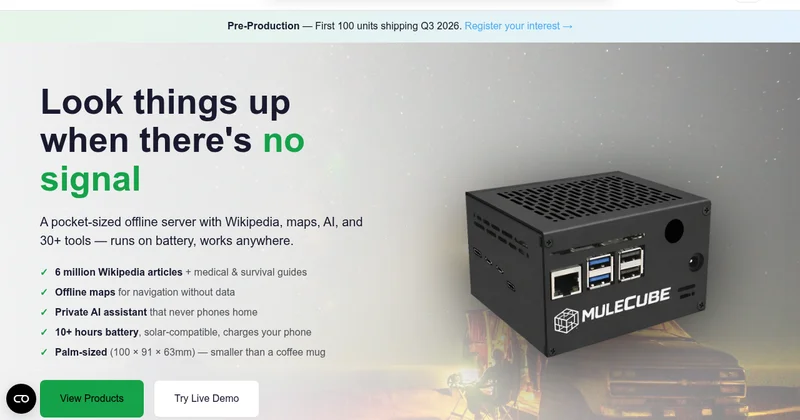
MuleCube
Pre-production · delivery unverified
A proposed portable box for offline reference material, maps and local applications.
Who it helps
Travellers, field researchers and small teams who need a local reference library when the internet is unavailable.
Approach and my contribution
Package a small computer, local Wi-Fi, stored content and applications into a portable device. It is the hardware proposition alongside CubeOS; MeshSat addresses the separate messaging problem.
I developed the product concept and its offline software and hardware approach, with AI-assisted development.
What works—and the limits
A product catalogue and browser demo are public. The purchase journey leads to registration of interest.
The interest page still promises Q3 2026, which has passed. Shipment and a replacement date are unverified, so I am not presenting MuleCube as shipping.
Evidence
Public materials show the proposed experience. Fulfilled orders, field adoption and the website’s early-user testimonials have not been independently substantiated for this portfolio.
Commercial status
The catalogue lists a free DIY option, a €99 SD-card kit and hardware from €499. These are published proposed offers, not evidence of sales or stock.
Next step
Confirm hardware and content readiness and publish a credible availability update. No revised shipment date is established.
Sources reviewed 2026-10-29: Pre-production interest page · Catalogue
Work with me
If you operate infrastructure, build communications hardware, or want to explore a suitable pilot, email me. I can walk through the implementation, its constraints and the evidence still needed.