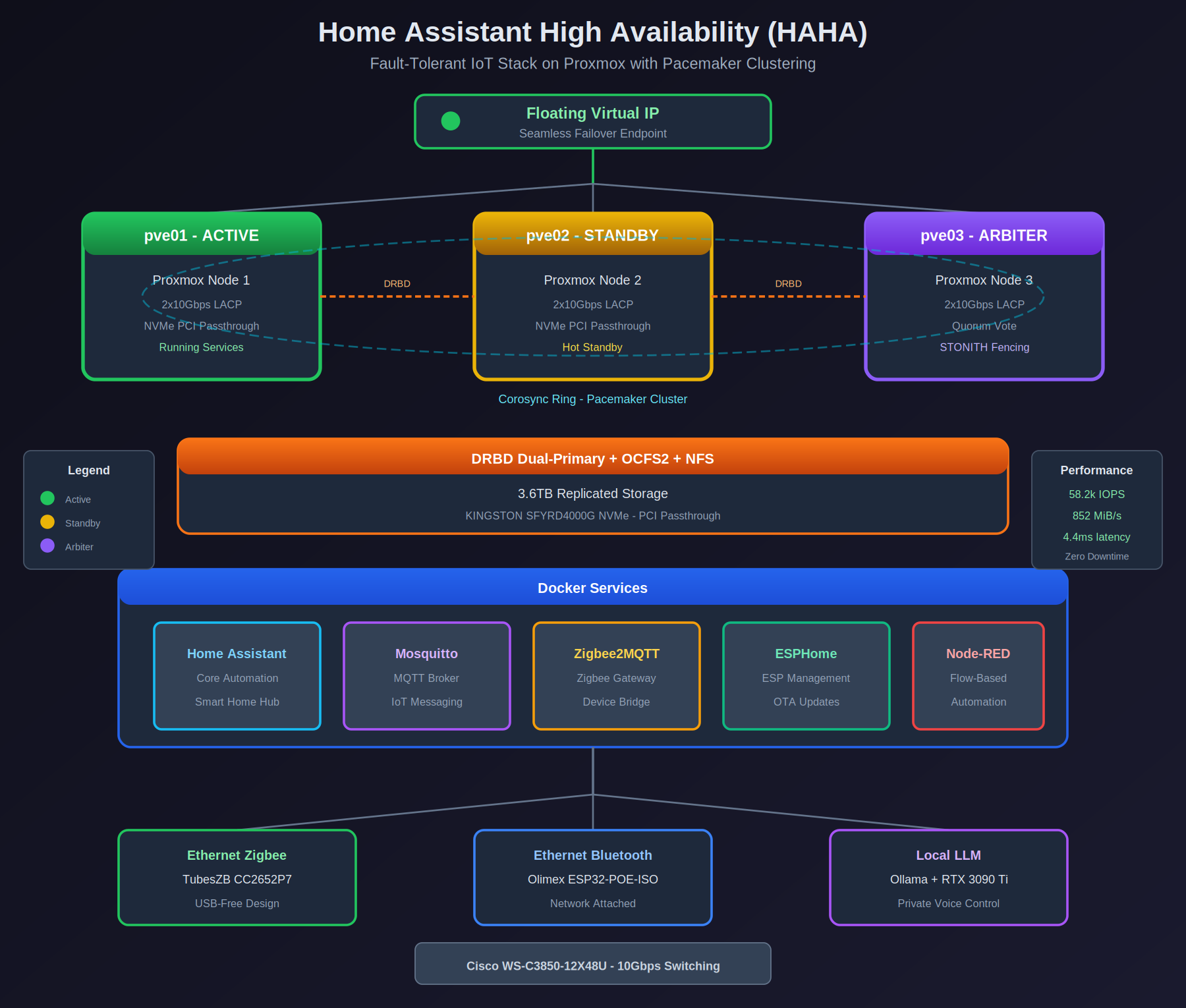
HAHA is a homelab project to build a fault-tolerant, high-performance smart home stack. Hosted on three Proxmox nodes, it ensures uninterrupted operation of key IoT services: Home Assistant, Mosquitto, Zigbee2MQTT, ESPHome, and Node-RED — all running in a high-availability cluster.
Overview
| Aspect | Details |
|---|---|
| Nodes | 3 Proxmox hosts |
| Clustering | Pacemaker + Corosync |
| Storage | 3.6TB DRBD dual-primary + OCFS2 |
| Network | 2x10Gbps LACP per node |
| Services | Home Assistant, Mosquitto, Zigbee2MQTT, ESPHome, Node-RED |
Technology Stack
Clustering
- Pacemaker + Corosync with STONITH fencing (3-node cluster)
- Floating virtual IP for seamless failover
- Quorum-based decision making
Storage
- 3.6TB DRBD dual-primary replication
- OCFS2 cluster filesystem shared via NFS
- KINGSTON SFYRD4000G NVMe drives with PCI passthrough
Networking
- LACP etherchannel (2x10Gbps per node)
- Cisco WS-C3850-12X48U switch
- Network-attached IoT peripherals (no USB dependencies)
Dockerized Services
- Home Assistant (core automation)
- Mosquitto (MQTT broker)
- Zigbee2MQTT (Zigbee gateway)
- ESPHome (ESP device management)
- Node-RED (flow-based automation)
IoT Peripherals
- Ethernet Zigbee: TubesZB CC2652P7
- Ethernet Bluetooth: Olimex ESP32-POE-ISO
- USB-free design for clean failover
AI Integration
- Local LLM (Ollama) on RTX 3090 Ti
- Private voice control and inference
- No cloud dependency
Architecture
┌─────────────────────────────────────────────────────────────────┐
│                    Floating VIP (Active)                         │
└───────────────────────────┬─────────────────────────────────────┘
                            │
    ┌───────────────────────┼───────────────────────┐
    │                       │                       │
    ▼                       ▼                       ▼
┌─────────┐           ┌─────────┐           ┌─────────┐
│ pve01   │           │ pve02   │           │ pve03   │
│ Active  │◄─────────►│ Standby │◄─────────►│Arbitrator│
│         │  DRBD     │         │  DRBD     │         │
└────┬────┘  Sync     └────┬────┘  Sync     └────┬────┘
     │                     │                     │
     │    Corosync Ring    │                     │
     └─────────────────────┴─────────────────────┘

┌─────────────────────────────────────────────────────────────────┐
│                    DRBD + OCFS2 + NFS                           │
│              (3.6TB Replicated Storage)                         │
└─────────────────────────────────────────────────────────────────┘
                            │
                            ▼
┌─────────────────────────────────────────────────────────────────┐
│                    Docker Services                               │
│  ┌──────────────┐ ┌──────────────┐ ┌──────────────┐            │
│  │Home Assistant│ │  Mosquitto   │ │ Zigbee2MQTT  │            │
│  └──────────────┘ └──────────────┘ └──────────────┘            │
│  ┌──────────────┐ ┌──────────────┐                              │
│  │   ESPHome    │ │   Node-RED   │                              │
│  └──────────────┘ └──────────────┘                              │
└─────────────────────────────────────────────────────────────────┘
                            │
         ┌──────────────────┼──────────────────┐
         ▼                  ▼                  ▼
┌─────────────────┐ ┌─────────────────┐ ┌─────────────────┐
│ Ethernet Zigbee │ │Ethernet Bluetooth│ │   Local LLM    │
│ TubesZB CC2652P7│ │ Olimex ESP32-POE │ │  RTX 3090 Ti   │
└─────────────────┘ └─────────────────┘ └─────────────────┘
Key Features
- Seamless failover via Pacemaker/Corosync
- High-speed, redundant storage with DRBD + NVMe passthrough
- USB-free Zigbee/Bluetooth to support clean failover
- Fully local voice assistant, no cloud dependency
Challenges Overcome
- Fine-tuned Pacemaker quorum and timeouts to avoid split-brain
- Stable dual-primary DRBD sync with OCFS2 lock handling
- Migrated from USB to Ethernet peripherals for failover stability
- Balanced low-latency storage and high throughput using LACP + passthrough NVMe
Performance Benchmarks
For IoT workloads, targets are: 50k IOPS, 200 MiB/s bandwidth, 5000 µs latency.
HAHA delivers:
- Random Read: 58.2k IOPS, 227 MiB/s, 4392.34 µs
- Sequential Write: 6.8k IOPS, 852 MiB/s, 9317.05 µs
Meeting or exceeding all targets despite OCFS2/DRBD/NFS network overhead.
Results
Achieved a resilient and scalable smart home infrastructure with zero single points of failure. The system gracefully tolerates node failures and restarts with no data loss or service interruption.
Skills Demonstrated
- Virtualization (Proxmox)
- High availability clustering (Pacemaker, Corosync)
- DRBD replication
- OCFS2 cluster filesystem
- LACP network bonding
- Docker containerization
- Home Assistant automation
- IoT integration
- Linux system administration
Part of the Nuclear Lighters homelab infrastructure