Skip to content
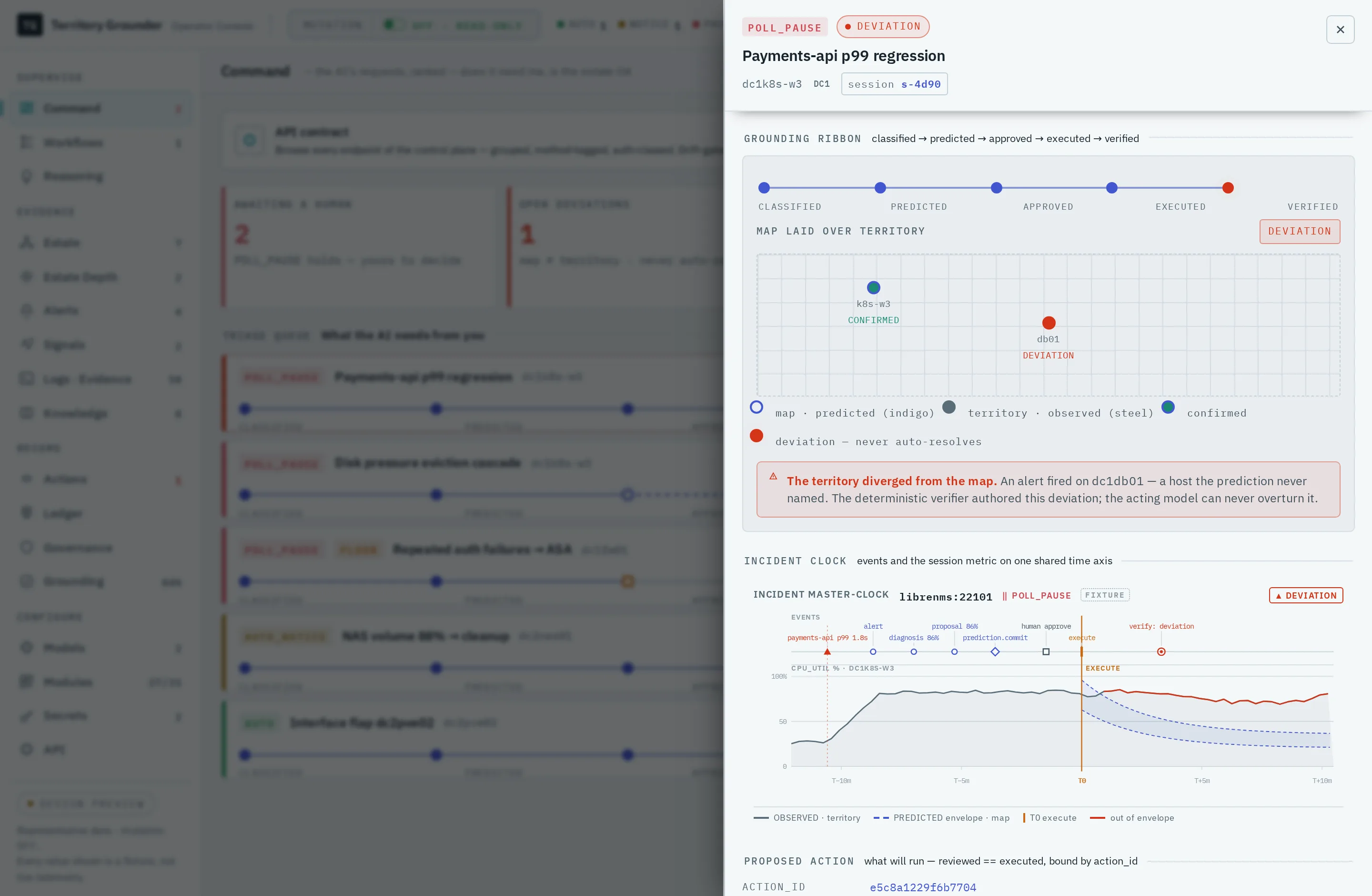
Territory Grounder operator console, Command view

Territory Grounder: Governed-Autonomy SRE Platform

Territory Grounder is an autonomous SRE agent that commits a prediction before it acts, then lets separate code decide whether reality agreed. The model that proposes a remediation never scores its own outcome, and no mutation runs on a belief the system has not independently checked. Territory Grounder is an open-source, self-hosted SRE platform: an LLM agent ingests alerts, chat messages, and tickets, triages incidents across Kubernetes, hypervisors, network, and storage, and (from Phase 2 on) executes remediations inside a mechanical governance envelope. It is the ground-up rewrite of Agentic ChatOps as a distributable product: Go and Temporal instead of Python, n8n, and cron. Same control logic, none of the code. ...
July 17, 2026 · Updated July 19, 2026 · 5 min · Kyriakos Papadopoulos
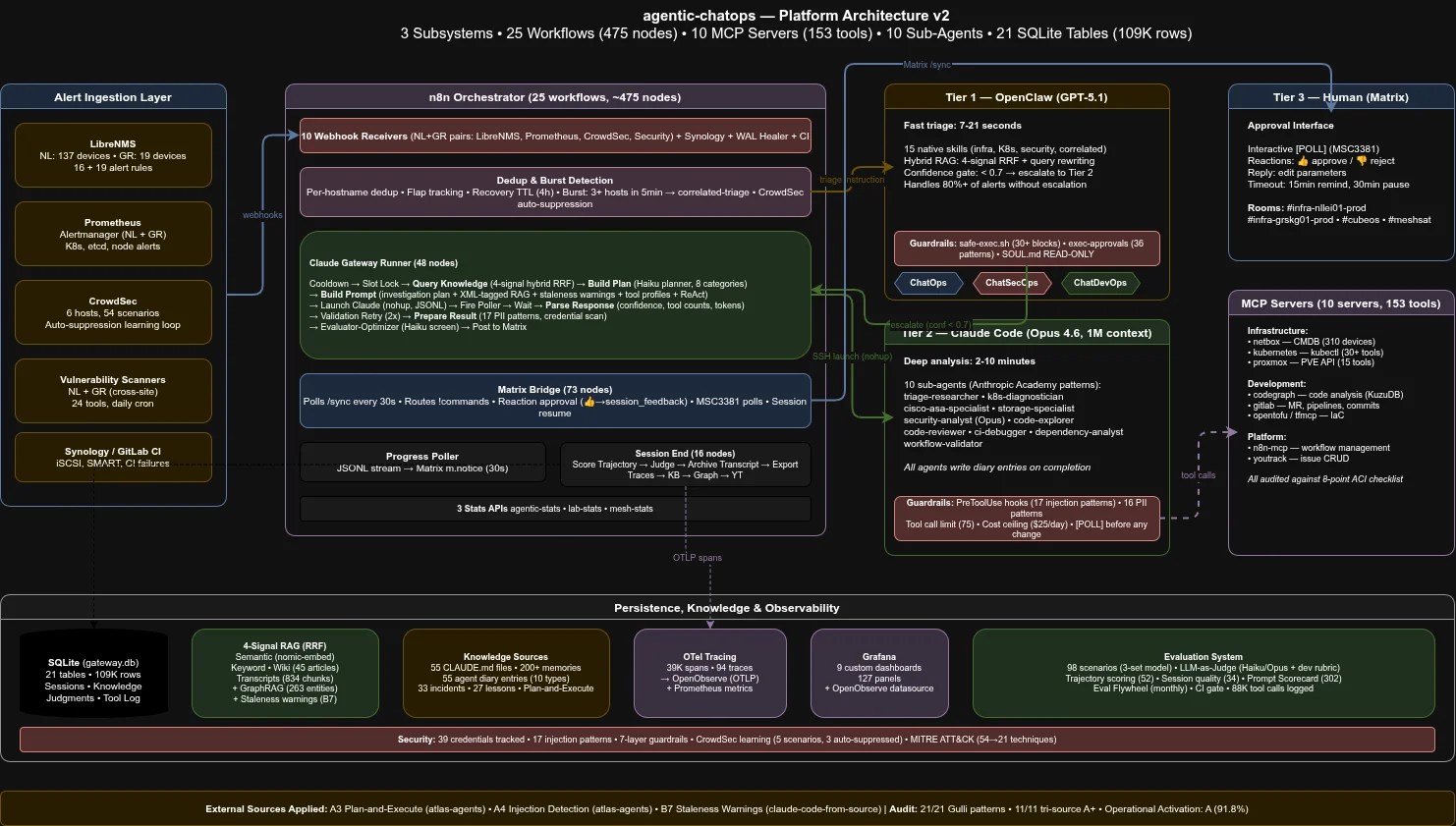
Agentic ChatOps Platform Architecture v2

Agentic ChatOps: AI-Powered Infrastructure Operations for a Solo Operator

Agentic ChatOps triages infrastructure alerts and predicts the consequences of each proposed fix before it acts — auto-resolving only the remediations a causal world-model can prove safe, behind a fail-closed, machine-verified prediction gate. Agentic ChatOps is a production system run by one person across 300+ infrastructure objects and five sites. Three AI subsystems triage alerts, investigate root causes, and propose fixes; a human approves every change. Two parts make it genuinely novel. First, a causal world-model of the infrastructure — a dependency graph that predicts the consequences of a proposed action before it can be approved, then verifies the outcome against that prediction in code. No remediation reaches a human’s approval without a machine-computed prediction attached, and the operator stays ring 0. Second, the whole agentic federation now runs under a self-governing control plane: a self-monitoring layer that inventories every moving part as a component with declared liveness and pages me the moment one goes dark, plus a Kubernetes-style self-healing controller that keeps the platform alive — reactivating dropped workflows, re-running failed jobs, restarting the scheduler — while never touching the mission decisions that stay behind the human gate. ...

April 7, 2026 · Updated July 9, 2026 · 31 min · Kyriakos Papadopoulos
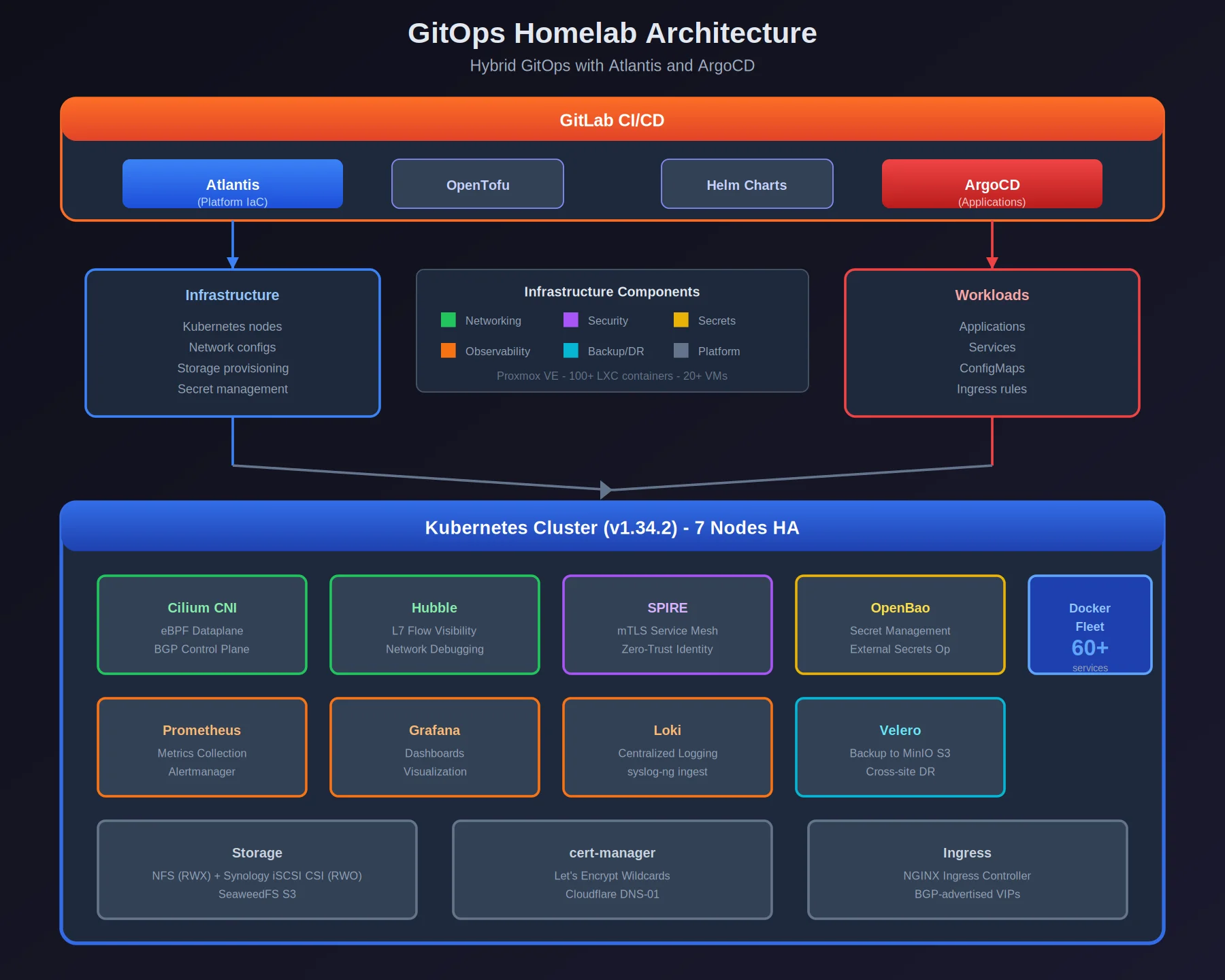
GitOps Homelab Architecture

GitOps Homelab: Full-Stack Infrastructure as Code

Everything in the homelab — network devices, VMs, Kubernetes workloads, Docker services, backups — is managed through GitLab CI/CD, Atlantis, and Argo CD. Nothing gets configured via SSH anymore. What It Covers Platform vs. application split — Atlantis/OpenTofu handles the infrastructure layer (nodes, networking, storage), Argo CD handles application workloads. Both triggered by merge requests, both with auto-sync. Kubernetes — 13-node HA cluster (7 in NL, 6 in GR; v1.34.2) with Cilium CNI replacing kube-proxy via eBPF. BGP peering with the Cisco ASA for LoadBalancer services. Dual storage: NFS for shared volumes, Synology iSCSI CSI for block storage. ...

November 1, 2025 · 3 min · Kyriakos Papadopoulos